TAILORING ELEMENT-SPECIFIC CURIE TEMPERATURES IN MAGNETIC TRILAYERS OF REDUCED DIMENSIONS
P. Poulopoulos and K. Baberschke
Institut für Experimentalphysik, Freie Universität Berlin, Arnimallee 14,
D-14195 Berlin-Dahlem, Germany
The reduced dimensionality and the interaction of magnetic layers through non-ferromagnetic ones via the interlayer-exchange coupling Jinter in multilayers revealed novel phenomena. The ultrathin magnetic layers which consist the multilayers have reduced Curie temperature (TC) due to finite-size effects. Bringing TC not much higher than the room temperature is a demand for applications. In this work we will show how to manipulate TC (i) in multilayers by modifying Jinter through a variation of the spacer thickness and (ii) capping the ultrathin films by a non-ferromagnetic layer. First, we show that by virtue of the element-specific x-ray magnetic circular dichroism (XMCD) it is possible to study the individual temperature dependence of Ni and Co magnetizations in ideal prototype Co/Cu/Ni/Cu(001) trilayers [1]. We find, remarkably, a separate onset of the magnetization for the different magnetic layers and an increase D T of the lower ordering temperature due to Jinter (Fig. 1). We show that the oscillatory character of Jinter is reflected on D T [2]. This allows us to tailor the ordering temperature in magnetic layered structures with Jinter as a parameter. From theoretical point of view the large D T is only understood within the framework of strong spin fluctuations that become larger at the two-dimensional limit [3]. New results recorded by ferromagnetic resonance and in situ SQUID magnetometry will be shown. In the second part of our work we study the effects of Cu-capping on ultrathin Co and Ni films grown on Cu(001). This study is important, since most of ultrathin films are used out of the UHV chamber and, thus, they have to be capped by protective layers. We show that both, the magnetic moments and TC of the magnetic layers, are modified after Cu-capping and a qualitative relation between them is suggested [4]. Thus, capping offers an additional parameter to tailor TC in ultrathin magnetic films.
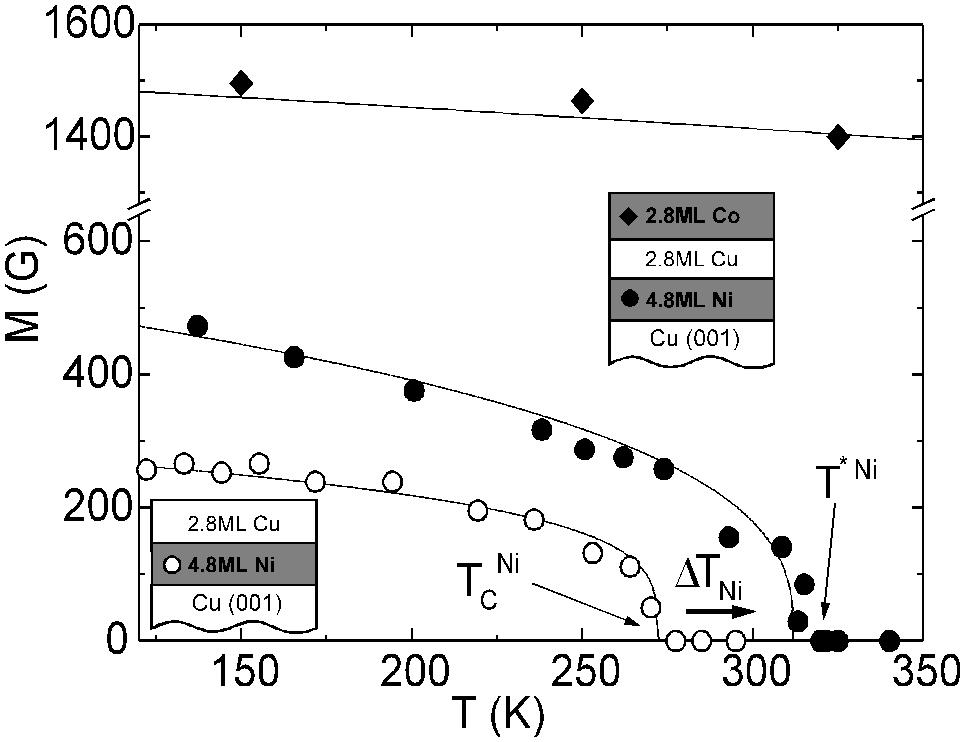
Fig.1 Though coupled, Co and Ni magnetization curves vanish at separate temperatures. The ordering temperature of Ni increases by an amount D T due to Jinter regardless of its ferro- or antiferromagnetic character.
[1] U. Bovensiepen et al., Phys. Rev. Lett. 81, 2368 (1998).
[2] A. Ney et al., Phys. Rev. B59, R3938 (1999).
[3] P.J. Jensen et al. Phys. Rev. B60, R14994 (1999); P.J. Jensen et al., (in this Symposium).
[4] F. Wilhelm et al., J. Appl. Phys. (in press).